Why dumping trade data into an LLM fails, and how specialized agents cut reconciliation exceptions. A 2% fail rate costs the industry $3bn a year.

Apexon Data & Analytics Practice

Agentic AI for Automated Large Volume Trade Reconciliation in Global Equities & Derivatives Domain

Why dumping trade data into an LLM fails, and how specialized agents cut reconciliation exceptions. A 2% fail rate costs the industry $3bn a year.

Executive Summary

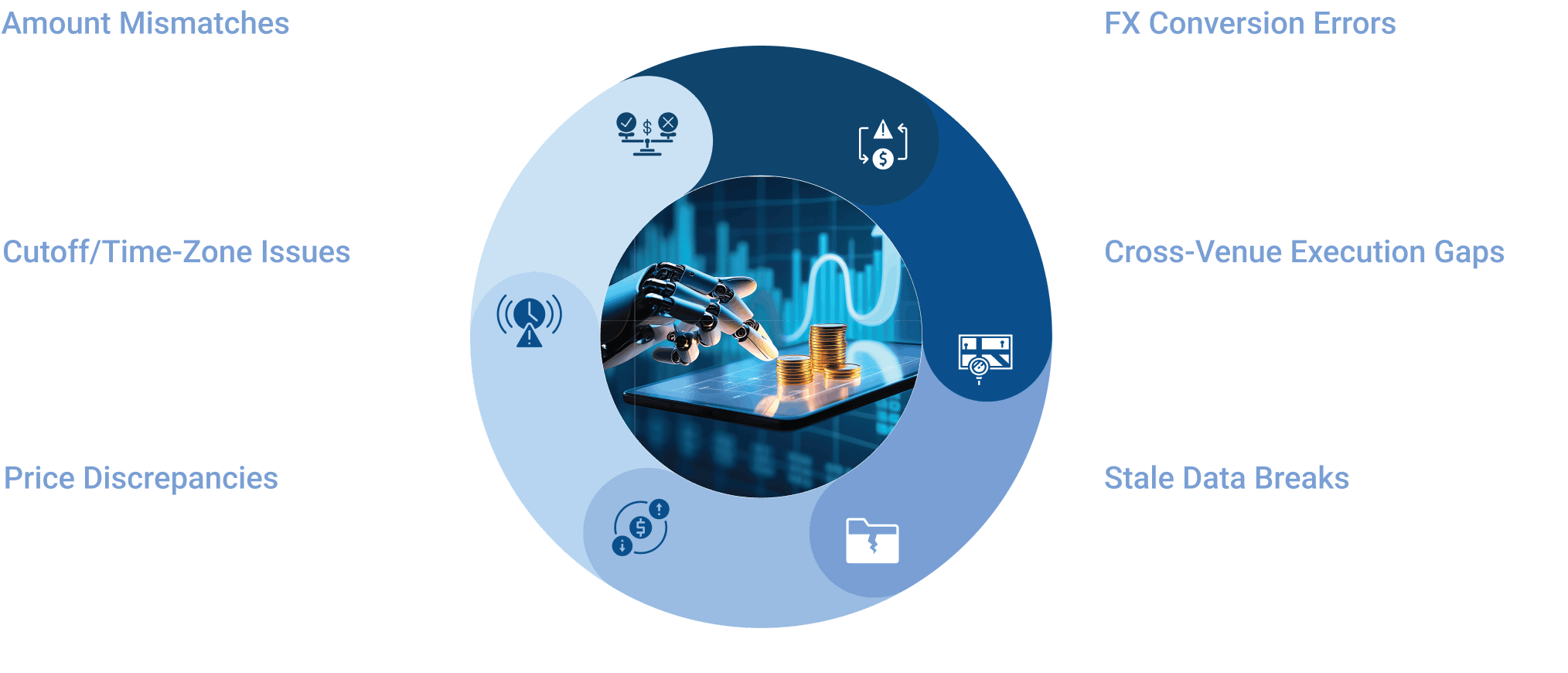
Post-trade reconciliation in global equities and derivatives is a major pain point for large banks. Every day, thousands of trade breaks occur (due to mismatched amounts, cutoff times, pricing errors, FX conversions, etc.), and most are still resolved by hand. These manual workflows are slow, error-prone, and costly: for example, a 2% trade-fail rate (typical in OTC derivatives) can cost the industry about $3 billion per year1. But can LLMs and Generative AI come to the rescue, to automatically reconcile these breaks and save significant manual cost? Simply dumping raw trade data into an LLM is impractical – given that trades of large investment banks run into millions and exception in tens or even hundreds of thousands, the context window and per-token costs would explode, and accuracy demands (~98–99% in trading) are very high2. Instead, agentic AI – i.e. systems of specialized AI agents – can be used to automate reconciliation at scale. This approach combines targeted tools, vector retrieval, and rules-based logic so the heavy lifting is done by smaller agents, not by one brute-force LLM. In this paper we

1

Detail today’s reconciliation challenges

2

Explain why naive LLM use fails

3

Outline agentic AI architectures (multi-agent pipelines, RAG, clustering, hybrid rule/LLM systems

4

Map solutions to specific break types

5

Survey AI reconciliation products (commercial and open-source)

6

Sketch a technical blueprint (with frameworks like LangGraph, AutoGen) for a next-gen AI-driven reconciliation platform

The conclusion offers a roadmap for banks to adopt these innovations safely and incrementally.

Depository Trust & Clearing Corporation (DTCC) survey a-teaminsight.com

The Trade Reconciliation Challenge Today

Trade reconciliation compares multiple systems’ records (front-office trade capture, exchange/clearing reports, custodians, etc.) to ensure all details agree. The classic reconciliation process involves six steps: data loading, matching, break classification, investigation, resolution, and reporting. In practice, large firms still see thousands of daily exceptions. Common break types include:

Resolving each break requires manual investigation. Operations staff must trace through trade tickets, confirmations, and market data. Legacy systems are often siloed and the data engineering beneath them is largely manual, so errors propagate until caught post-trade. Industry veterans3 notes, “post-trade reconciliation: legacy and siloed systems… mean data integrity issues result in manual interventions”. Similarly, they warn that reconciliations are “slow, manual, and prone to errors”. This inefficiency has real cost: a single failed settlement can cost tens of thousands of dollars, and systematic breaks can strain liquidity and risk compliance.

Reconciliation must match two or more datasets to verify they agree. Typically this involves loading the data, matching entries, classifying breaks, researching causes, resolving the discrepancy, and generating reports. In practice, investment banks invest enormous manual effort in these steps.

3. Why Naive LLMs Don’t Scale on Raw Trade Data

A tempting idea is to just feed all trade data into a large language model (LLM) and ask it to detect mismatches. In reality, this is costly and unreliable. Raw trade records are huge, highly structured numeric/tabular data – not natural language – so batching them into an LLM requires extreme context lengths. The token count (and thus inference cost) explodes if you try to load a full day’s book. For example, even a thousand trades with a few dozen fields each could consume tens of thousands of tokens per query. At typical LLM API pricing, this quickly becomes expensive and slow. Moreover, LLMs excel on free-form text, but have well-known limitations with precise numeric reasoning or 100%-accurate detail extraction. Traders report that “LLMs, trained primarily on textual corpora… when you’re taking a piece of text and turning it into a structured inquiry, it has to be correct… we need something like 98–99% accuracy for this”4. Achieving that level of reliability purely with a black-box LLM is very difficult.

Instead of brute-forcing with monolithic models, in this whitepaper, we propose an intelligent reconciliation using orchestration of specialized tools. For instance, an LLM can parse free-text trade confirmations, but a deterministic algorithm or a specialized numeric model should do rigid match-fields. Rule-based logic can quickly filter obvious matches (e.g. exact ID and quantity matches) so only true discrepancies go to higher-level agents. In short, feeding the entire trade database to GPT is impractical. Modern strategies must focus on retrieval-augmented workflows and multi-agent systems where LLMs are used sparingly (for e.g. unstructured data or decision-making) and most matching logic runs in optimized routines.

4. Why Naive LLMs Don’t Scale on Raw Trade Data

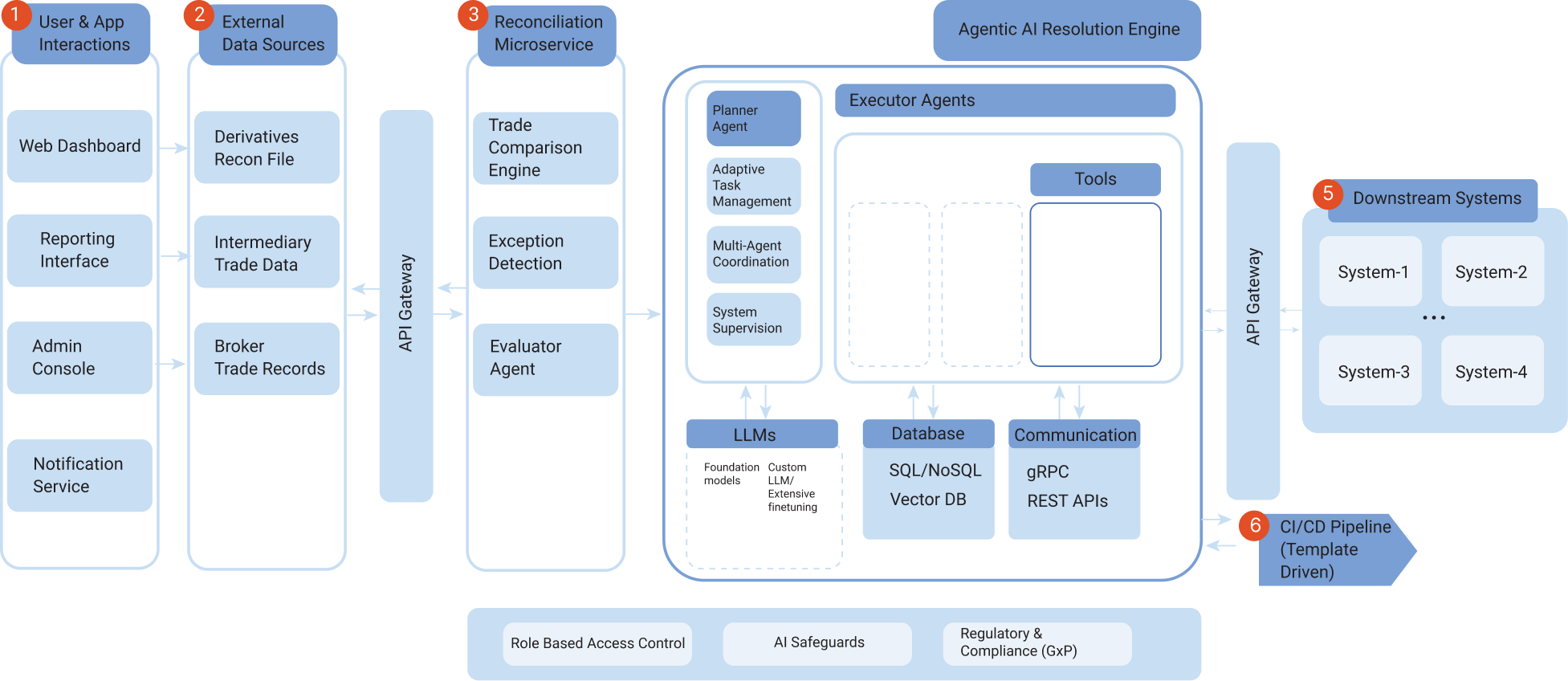
To tackle reconciliation at scale, we propose looking at agentic AI – systems of many cooperating agents, each with a focused role. Rather than one giant AI trying everything, you build a network of specialized agents (some powered by LLMs, others by rules or smaller models) and orchestrate them with a controller or “planner” agent. For example, LangGraph’s vision of multi-agent AI breaks tasks into: a Planner Agent that breaks the goal into subtasks, various Executor Agents (tools) that perform retrieval, computation, or API calls, a Communicator Agent that translates outputs between agents, and an Evaluator Agent that checks quality and loops back if needed. The figure below (adapted from LangGraph) illustrates a typical workflow:

a-teaminsight.com

  • 3 The Reconciliation Microservice detects trade mismatches, validates data, and ensures accurate reconciliation.

  • 5 The model-corrected data will be automatically identified and fed into downstream streams.

  • 3 Multi-agent orchestration with LLMs, Vector DBs, and RAG tools for autonomous decisions in clinical & business workflows, using foundation or custom LLMs via Nvidia NIM.

  • 5Template-driven CI/CD automates and standardizes code deployment pipelines, enabling us orchestrate, validate and optimize agent releases with greater speed and accuracy.

Figure: LangGraph-style multi-agent architecture (2025). A Planner agent orchestrates tasks among Executor agents (e.g. a RAG retrieval tool, a code-execution tool), with Communicator and Evaluator agents ensuring outputs are correctly passed and validated.

Key patterns in such agentic architectures include:

Multi-Agent Decomposition

Assign agents to subtasks. For reconciliation, one agent may ingest and normalize trade data, another performs matching logic, another classifies exceptions, another runs corrective actions, etc. These agents communicate
via a shared memory or state store (often a vector database). The orchestrator (planner) decides which agent to invoke next based on the situation.

Retrieval-Augmented Pipelines

Equip agents with retrieval from knowledge bases. For instance, a “Reference Data Agent” might use a vector DB or knowledge graph to fetch instrument details (currency, tick size, etc.) or past-resolution history. This is essential for context: e.g. to explain a price difference, an agent could retrieve a relevant trade contract or news. A LangGraph RAG executor (one type of agent) might query a database of past trade rules or API documentation.

Rules-Based Trigger Agents

Certain cases can be handled by deterministic logic. For example, if a break is due to a cutoff-time (e.g. trade time after cutoff), a Cutoff Agent can automatically tag and reroute it. A Currency Agent could apply known FX conversion logic for multi-currency trades. Rule Agents can catch simple cases at very high speed.

Embedding-Based Clustering/Triage

When exceptions flood in, it helps to group similar breaks. Here an Embedding Agent could encode each exception record into a vector (using something like an encoder model) and cluster them. If dozens of trades
have the same off-by-1 quantity error, they get batched. This reduces redundant investigation. Clustering agents help prioritize: rare patterns are flagged for human review, while routine classes can be handled automatically.

Hybrid Symbolic/LLM Systems

For the toughest cases, combine symbolic (hard-coded) logic with an LLM. For example, once an exception is isolated, an LLM-powered agent might generate a natural-language diagnosis (“price off by 0.5% vs reference price on the trade date”) and suggest actions based on learned patterns. But it would do so using inputs prepared by strict rules (so as not to hallucinate numeric detail).

The overall agentic workflow might look like an assembly line or a pipeline.

5. Agentic Pattern-Based Trade Reconciliation Pipeline

An agentic AI pipeline decomposes complex reconciliation into specialized sub-tasks, each handled by an autonomous agent. Such multi-agent architectures (as advocated by LangChain and CrewAI) break problems into smaller focused agents coordinated by a controller. In our design, an orchestration layer (e.g. LangChain’s supervisor or CrewAI “manager” agent) sequences seven components: identifying candidate trades, mapping columns, generating match patterns, validating/executing them, storing the patterns, running multi-day aggregation, and producing a narrative report. This modular approach parallels multi-agent pipelines in other domains. It also allows using any LLM backend (LLM-agnostic) via frameworks like CrewAI or LangChain, which can invoke different models or on-premise LLMs without changing the design. Crucially, no raw trade data is dumped into an LLM. Instead, patterns (rules) are generated and stored outside the model, enabling reuse and the data governance auditability a regulated firm has to evidence. This maximizes LLM efficiency and privacy: the LLM reasons about patterns and exceptions, not gigabytes of transaction rows.

WHITEPAPER OVERVIEW
What you’ll learn in this Whitepaper

Explore the evolution of AI-assisted technology modernization—from quantifying technical debt and understanding the rise of agentic AI to Apexon’s context-first framework, multi-agent architecture, migration methodology, and real-world success.

01
The why
Challenge & technology evolution
01Executive Summary
02The Technical Debt Crisis: Quantifying the Challenge
03Industry Context and Technology Evolution Drivers

02
The how
Agentic AI & strategic approach
04The Emergence of Agentic AI for Code Modernization
05Strategic Differentiation: Apexon’s Context-First Approach
06The Context Engineering Framework for Technology Migrations

03
The practice
Architecture & migration execution
07Technical Deep Dive: Multi-Agent Architecture
08Three Critical Migration Domains
09The Assessment-Planning-Execution Methodology

04
The path forward
Proof, outlook & future
10Case Study: Framework Migration Success
11Outlook: The Evolution of AI-Assisted Modernization
12Conclusion

FAQ’s – Agentic AI for Trade Reconciliation

Trade reconciliation compares records across multiple systems, including front-office trade capture, exchange and clearing reports and custodians, to confirm every detail agrees. The classic process runs six steps: data loading, matching, break classification, investigation, resolution and reporting. Large firms still see thousands of daily exceptions despite that structure.

Agentic AI for trade reconciliation uses autonomous AI agents to validate, compare, investigate and resolve trade discrepancies across multiple financial systems with minimal human intervention. It improves reconciliation speed, operational accuracy and scalability for capital markets, replacing one monolithic model with a network of specialized agents.

Raw trade records are large, structured numeric data rather than natural language, so loading a full day’s book into a model drives token counts and inference costs up sharply. Trading requires 98 to 99% accuracy, and language models have well-known limits on precise numeric reasoning, which a black-box approach cannot reliably meet.

By decomposing it rather than brute-forcing it. Rules-based agents clear obvious matches at speed, retrieval-augmented agents fetch reference data and past resolutions, embedding agents cluster similar breaks for batch handling, and a language model is used sparingly for diagnosis. No raw trade data is passed into the model.

Agentic AI intelligently matches trade records from multiple systems, detects data inconsistencies, investigates root causes, and recommends or executes corrective actions. Clustering similar breaks removes redundant investigation, so routine classes are handled automatically and rare patterns are flagged for human review. This lowers unresolved reconciliation breaks.

Yes. Agentic AI automates repetitive reconciliation tasks, shortens processing cycles, improves straight-through processing, reduces operational costs, and lets operations teams focus on higher-value exception handling. It supports post-trade operations across global equities, derivatives, clearing, settlement, exception management, trade validation and regulatory reporting.