The financial sector’s dependence on complex digital ecosystems—comprising software supply chains, cloud infrastructures, and real-time analytics pipelines—has made information security a core determinant of operational resilience. As investment banks digitize trading, collateral, and margin systems, the potential attack surface has multiplied. Adversaries increasingly exploit API dependencies, CI/CD vulnerabilities, and open-source packages to infiltrate production systems. The Digital Operational Resilience Act (DORA) and similar global mandates now formalize the expectation that banks not only defend against such disruptions but also demonstrate resilience through evidence-backed governance, continuous testing, and rapid recovery capabilities.
In the past decade, large global banks like J.P. Morgan and Citi have faced sophisticated threats targeting their algorithmic trading infrastructure and cloud-native risk models. For instance, the 2023 supply-chain compromise in a major European bank’s analytics pipeline exposed sensitive market data through a third-party vendor library—an attack that bypassed traditional rule-based monitoring. Meanwhile, Bank of America and Wells Fargo have reported exponential increases in social engineering and credential-stuffing attempts powered by generative AI. These examples illustrate that even the most mature SIEM and SOAR environments, while extensive, often remain reactive—focused on detection rather than autonomous prevention and remediation.
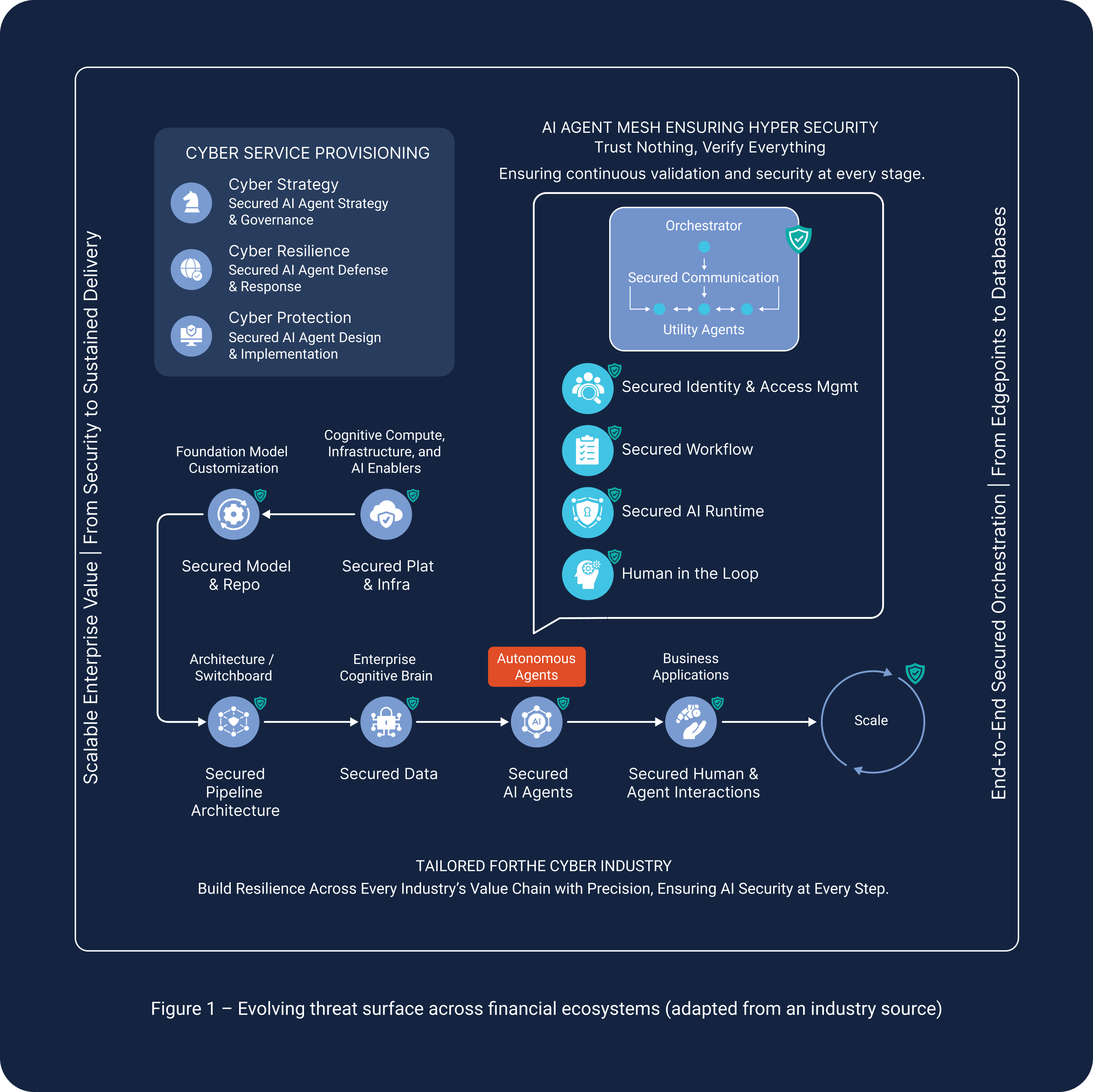
A generation of new age AI solutions – autonomous, goal-driven security services capable of sensing, reasoning, acting, and learning with human-in-the-loop governance. Unlike traditional automation scripts, Agentic AI continuously interprets control frameworks, learns from system telemetry, and executes safe, explainable fixes. For instance, A large global bank’s engineering division has piloted AI-driven regression mapping for “break-pattern detection” in derivatives operations, while Morgan Stanley applies AI to dynamically test cyber controls across distributed trading nodes. These initiatives move the security model from “find and file” to “find, fix, and prove,” closing the loop between detection and remediation.
Apexon’s Agentic AI Framework builds on this evolution. It autonomously translates regulatory text and policy changes—such as those in DORA, NIS2, and GDPR—into live control maps. It continuously monitors systems across payment, margin, and trading domains; detects deviations; and proposes or executes secure remediation actions. Each intervention is logged with audit-grade evidence, ensuring explainability and trust. This framework enables banks to not only meet compliance thresholds but to outperform resilience SLOs by automating fix-cycles, optimizing control coverage, and reducing mean time to recovery (MTTR) across complex hybrid estates.
This paper outlines the emerging industry challenges surrounding DORA implementation and explores how Apexon’s GenAI-enabled regulatory intelligence framework empowers financial institutions to build resilient, scalable, and audit-ready compliance ecosystems — safely and efficiently.