A Trust-First, Protocol-Driven Blueprint to EnableAI Agents to Discover, Decide, and Pay Securely —while Preserving Merchant Control

THE AI SANDBOX

Enabling Responsible, Scalable Innovation in the Global Payments Ecosystem

A Trust-First, Protocol-Driven Blueprint to EnableAI Agents to Discover, Decide, and Pay Securely —while Preserving Merchant Control

1. Executive Summary

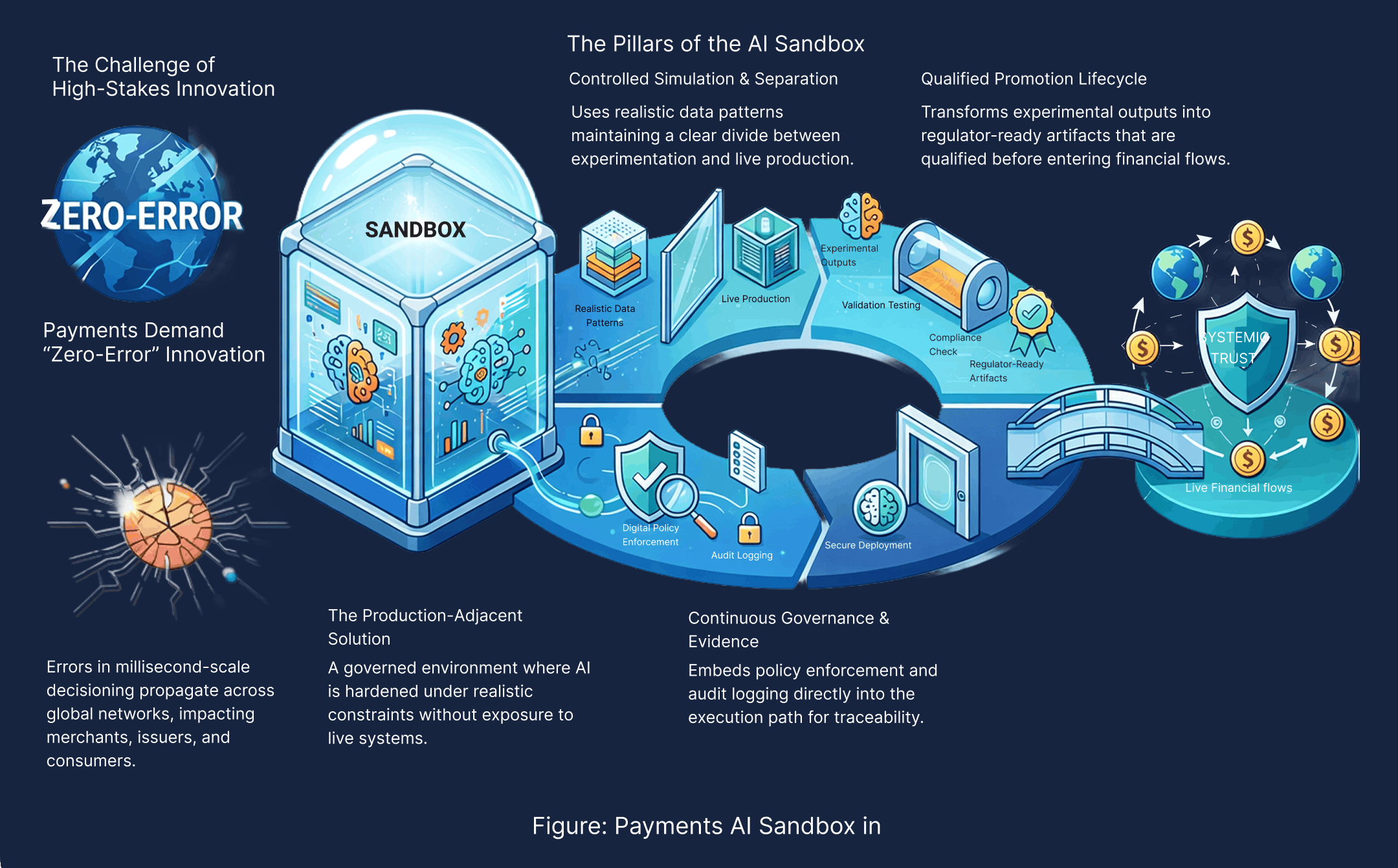
Artificial intelligence is becoming structural to the payments industry. Fraud detection, authorization decisioning, dispute resolution, customer servicing, and operational resilience increasingly depend on AI-driven signals and reasoning. Yet payments is not a typical digital domain. It is a regulated, multi-party, cross‑border ecosystem where decisioning happens in milliseconds and errors can propagate to merchants, issuers, acquirers, and consumers at network scale. For payment ecosystems, “move fast and break things” is not a viable innovation strategy.

This white paper introduces the AI Sandbox as strategic infrastructure for payments: a governed, production‑adjacent environment where AI models, large language models, and agentic workflows can be tested, evaluated, and hardened under realistic constraints without exposure to live transaction systems. Unlike generic innovation labs, a payments AI Sandbox embeds policy enforcement, traceability, audit logging, and evaluation into the execution path so that experimentation outputs are inherently promotable, regulator‑ready artifacts rather than throwaway prototypes.


The core premise is simple: payment organizations need a repeatable path from idea to deployment that balances innovation velocity with systemic trust. The AI Sandbox operationalizes that balance through
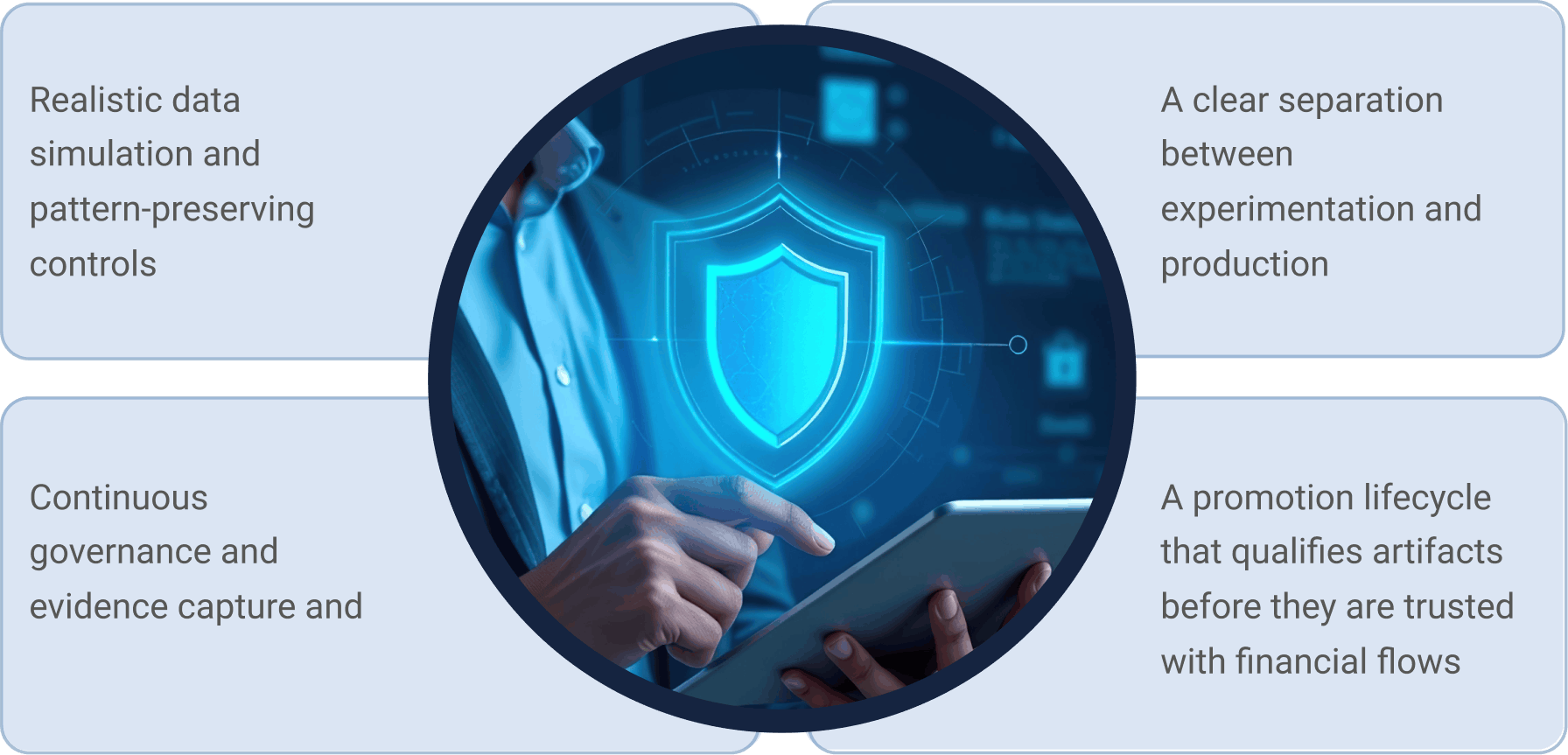
The outcome is faster innovation with lower risk: fewer dead‑end pilots, clearer accountability, and a defensible basis for scaling AI across the payment lifecycle.

The AI Sandbox: Bridging Payments Innovation and SystemicTrust

2. Payments Innovation in the Intelligent Systems Era

Payments has evolved from batch settlement rails to real‑time decisioning infrastructure. Modern transaction journeys incorporate tokenization, device and behavioral signals, risk scoring, issuer decisioning, merchant routing, and downstream exception handling. The payment network’s role is no longer limited to connectivity; it is increasingly an orchestrator of trust, resilience, and shared standards across a diverse ecosystem of participants.


The industry’s technology stack reflects this shift. ISO 8583 and ISO 20022 coexist with API‑driven modern interfaces. Event streaming is common for fraud and operational telemetry. Real‑time payments and instant settlement expectations raise the bar for latency and availability. In this environment, AI becomes attractive because it can reason over complex, high‑dimensional signals and adapt to emerging patterns faster than static rules.


AI failures in payments have asymmetric consequences. A false‑positive fraud model can block legitimate commerce at scale. A poorly governed authorization optimization can create biased outcomes across regions or merchant categories. An opaque customer‑service agent can provide inconsistent or non‑compliant guidance. These outcomes can trigger regulatory scrutiny, contractual disputes, and reputational harm. Importantly, payments are systemic: one participant’s behavior can cascade through the ecosystem.


This is why payments innovation must treat explainability, auditability, security, and human oversight as core requirements rather than optional controls. In practice, it means AI experimentation needs a controlled environment that mirrors real operational constraints while ensuring that sensitive data and live systems remain protected.

As fraud tactics evolve and customer expectations rise, competitive differentiation increasingly comes from “intelligent trust”: the ability to approve more legitimate transactions, block more fraud, resolve disputes faster, and keep experiences consistent all while satisfying regulators and partners. Achieving this requires faster learning cycles than traditional development and testing can support.


The AI Sandbox is a response to this new competitive surface. It enables continuous experimentation with guardrails so organizations can learn safely and scale confidently.

Whitepaper Overview
What you’ll learn in this Whitepaper

Explore the evolution of intelligent payments — from the AI opportunity and foundational architecture to responsible adoption, agentic commerce, and the path toward autonomous payment systems.

01
The opportunity
Context & foundations
01Executive Summary
02Payments Innovation in the Intelligent Systems Era
03Defining the AI Sandbox for Payments

02
The architecture
Framework & infrastructure
04Reference Architecture and Core Components
05Safe Data Handling, Security, and Governance
06Responsible AI, Risk, and Regulatory Alignment

03
The transformation
Autonomy & industrialization
06Agentic Commerce: Protocol-Driven Autonomous Payment Workflows
07From Experimentation to Industrialization
08Ecosystem Operating Model and Measurement

04
The path forward
Strategy & future state
09Apexon Point of View and Differentiated Approach
10The Road Ahead: Toward Adaptive and Autonomous Payments