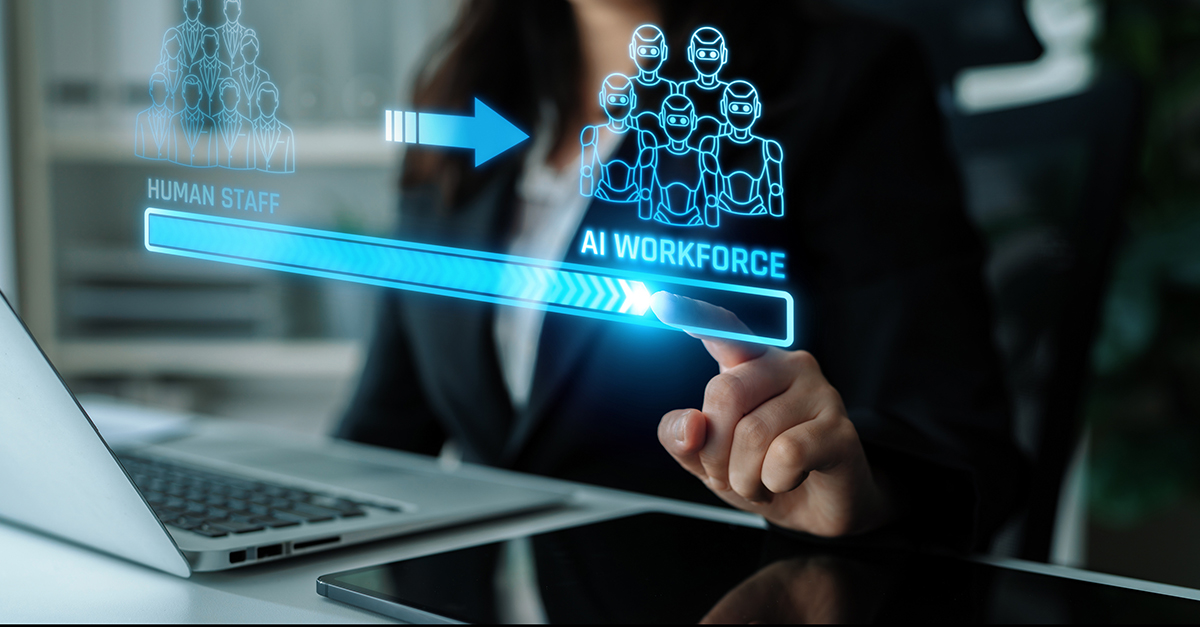
AI agents are no longer “tools”—they are your newest digital employees. In the last six months, your organization has likely “hired” dozens, if not hundreds, of them. They are tireless, they don’t drink the office coffee, and they process libraries of data in seconds.
But as we integrate these agents into core workflows—granting them access to proprietary code, customer PII, and system credentials—we face a familiar management challenge. If we treat AI like simple software, we fail. If we treat it like a workforce, we realize we are missing a critical department: HR for AI.
It’s time for HR to evolve into “HAIR” (Human and AI Resources)—or for your Cybersecurity team to start thinking like personnel managers.
Also Read: Apexon Banking360 Suite: AI-Driven Customer Insights for FSIs
The Trust Fall: Why We Manage Humans, Not Just “Tools”
Think about your star performer. They have a stellar resume and passed every interview. You entrust them with your company’s “crown jewels.” Can you guarantee 100% that they will never make a mistake or break your trust? No.
We accept this “human risk” because we have Human Resources. HR doesn’t just hire; they govern. They use attendance systems, conduct performance reviews, and enforce behavioral policies.
LLMs are built on probabilistic weights, not rigid logic. Because they are modeled after human neural networks, 100% accuracy is mathematically impossible. Just as you trust a human employee while verifying their work, you must do the same for AI.
Also Read: Beyond the Model: Embedding Domain Expertise into AI for Real Impact
Enter the “HAIR” Team: A New Governance Blueprint
Who “owns” the behavior of an autonomous agent? IT? The AI Center of Excellence? Or is it time for a merger? The HAIR Team (Human and AI Resources) isn’t just a clever acronym; it’s a necessary shift in mindset.
| Human HR Function | AI “HR” (Cybersecurity) Function |
|---|---|
| Attendance & Logs: Is the employee at their desk? | Uptime & Latency: Is the agent active or “AWOL”? |
| Code of Conduct: Rules against harassment. | Guardrails (e.g., NeMo): Preventing toxic outputs. |
| Performance Reviews: Checking for growth/errors. | Model Evals: Detecting hallucinations or drift. |
| Background Checks: Vetting a person’s history. | Supply Chain Security: Vetting training data/weights. |
The Double Standard: Why We Forgive Humans but Fear AI
If a human supply chain manager miscalculates an order and costs the company $50k, we call it a “learning opportunity.” If an AI agent does the same, Legal often calls for a total shutdown.
A well-governed AI system today often has a lower error rate than a distracted human. If we accept a 5% error rate from a human but reject a 2% rate from an AI, we aren’t being “safe”—we are being inefficient. We must stop viewing AI mistakes as “system bugs” and start seeing them as the “cost of efficiency.”
Also Read: Meet Your New AI Marketer: Driving Smarter, Autonomous Marketing with Agentforce
The Bottom Line: Building the Handbook
AI is not a software update; it’s a workforce expansion. We don’t stop hiring humans just because they aren’t 100% predictable; we build systems to manage them.
To thrive in this era, stop looking at Cybersecurity as just a “lock on the door.” Start looking at it as the governance framework—the HAIR team—that allows your AI agents to work safely, ethically, and productively.
Is your organization ready to pivot to a “HAIR” model? At Apexon, we help organizations build this trust layer through our TRUST-AX Blueprint, ensuring your AI workforce is as reliable as your human one.