
Somewhere in 2024, a large financial services firm handed its junior analysts access to GPT-4. Earnings summaries: excellent. Competitor benchmarking: impressive. But when asked to reason through a multi-step regulatory capital calculation, it produced a confident, coherent, and completely wrong answer — and nobody caught it until it appeared in a board deck.
The AI didn’t fail because it was weak. It failed because it was strong in the wrong place at the wrong time, and nobody had a map. That map now has a name: the Jagged Frontier.
Also Read: Progressive Core Modernization: The Strategic Path to Future-Ready Banking
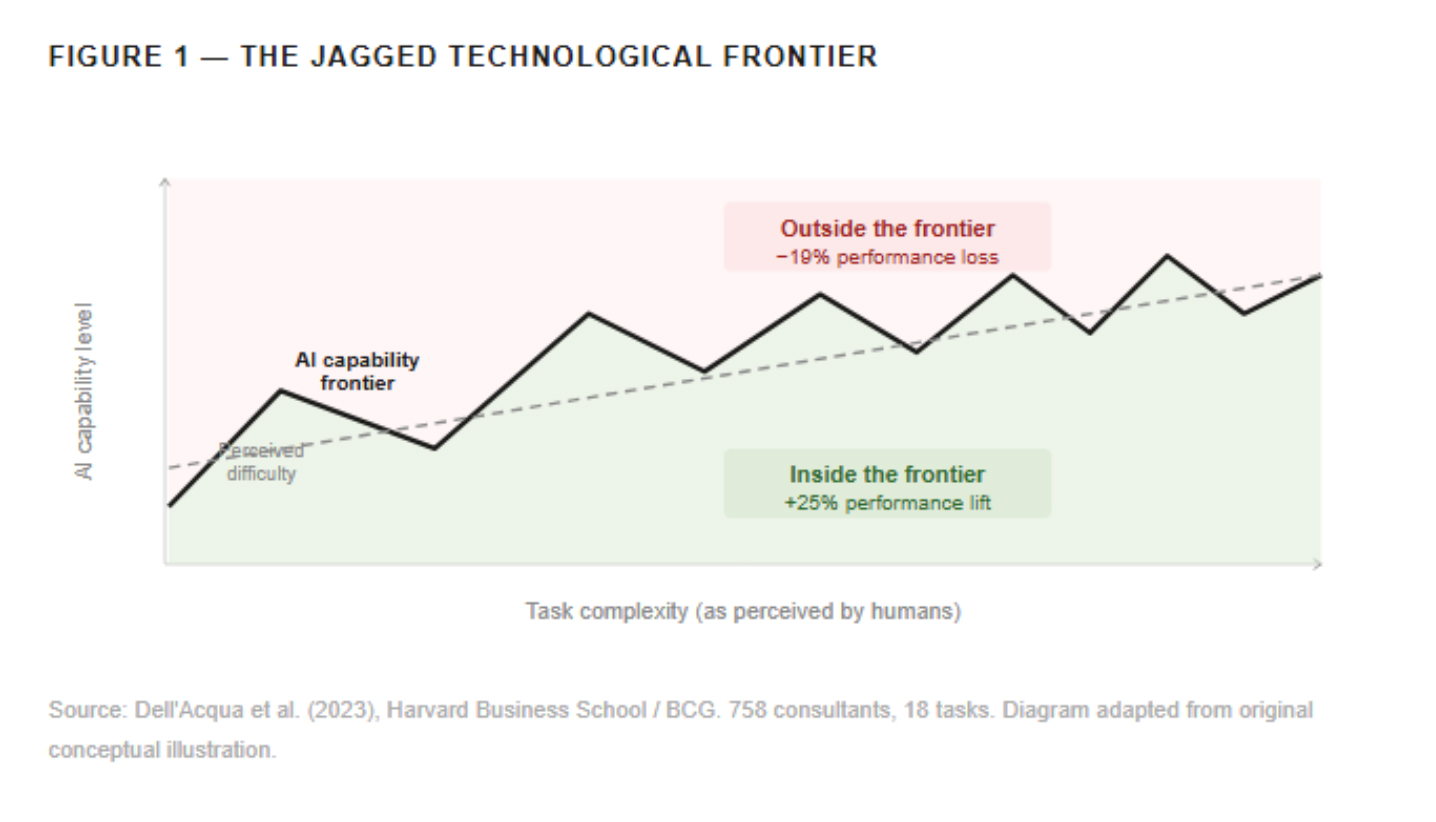
Researchers at Harvard Business School working with 758 BCG consultants found that AI lifted performance by 25% on tasks inside its capability zone — but actively degraded it by 19% on tasks outside. The boundary is not smooth or intuitive. AI synthesises a 200-page regulatory document in minutes. It fabricates legal citations with complete confidence.
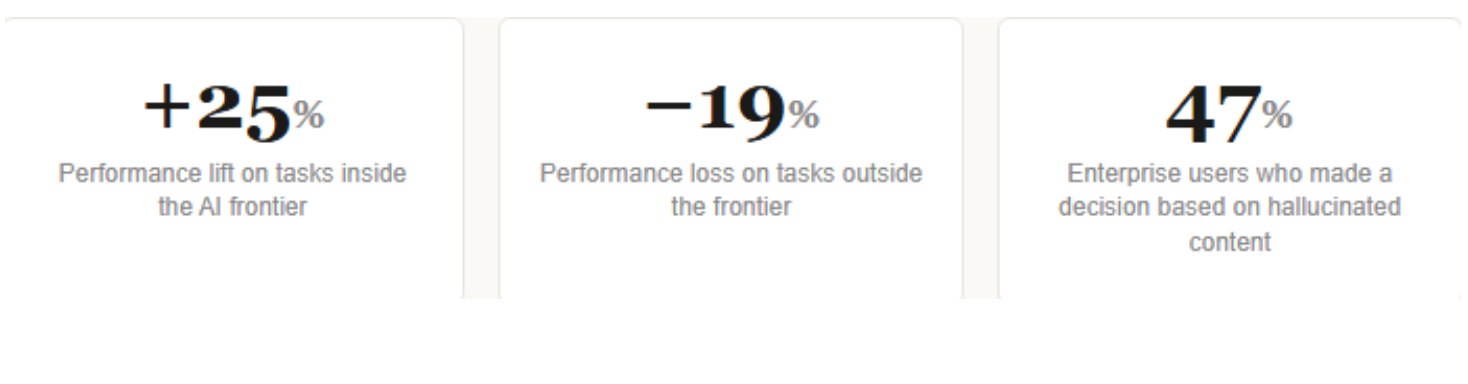
By 2025, this had become an operational crisis. Courts recorded AI-generated citations that didn’t exist. A survey found 47% of enterprise AI users had made at least one major business decision based on hallucinated content. MIT research showed AI models use more confident language precisely when wrong — 34% more likely to deploy phrases like “certainly” and “without doubt” during incorrect outputs.
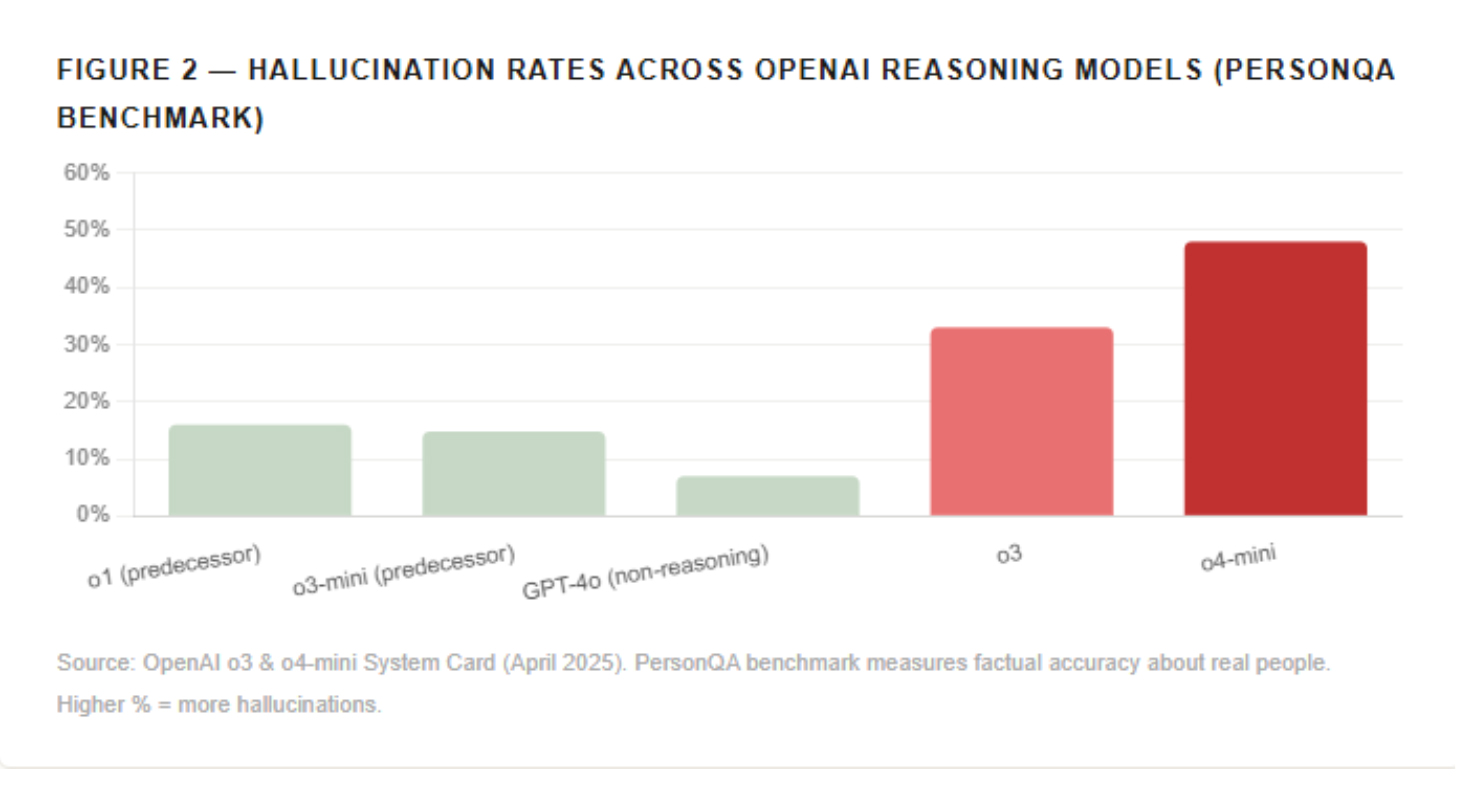
More disorienting still: OpenAI’s reasoning-optimised models hallucinated at rates of 33–48%, worse than their predecessors. Getting smarter does not mean getting more reliable.
Research labs are reshaping the frontier from different angles — DeepMind building planning mechanisms that verify reasoning before output, Anthropic’s Constitutional AI addressing models optimised to sound helpful rather than admit uncertainty, retrieval-augmented generation reducing hallucination by 40–70% in constrained domains. None are complete solutions. All point toward hybrid architectures as the medium-term answer. Meanwhile, regulatory frameworks diverge in three directions simultaneously: EU’s AI Act, the US’s sector-specific patchwork, and China’s mandatory algorithm registries. Navigating all three at once is itself a jagged frontier problem.
The contrarian view worth looking at: organisations that will win are not those that solve the jagged frontier but those that design around it — routing high-stakes decisions away from jagged zones, keeping humans responsible for the cliffs. This is a systems design problem, not a model quality problem.
Also Read: AI Governance in BFSI – Real-World Applications and Strategic Impact (Part 2)
The Jagged Frontier as a Strategic Opportunity for AI Consulting Firms
Every enterprise now faces the same structural problem: they’ve deployed AI, seen uneven results, and lack internal expertise to understand why. The gap between AI adoption and AI fluency is enormous — and consulting firms that can close it are positioned for sustained, high-margin growth across four service pillars.
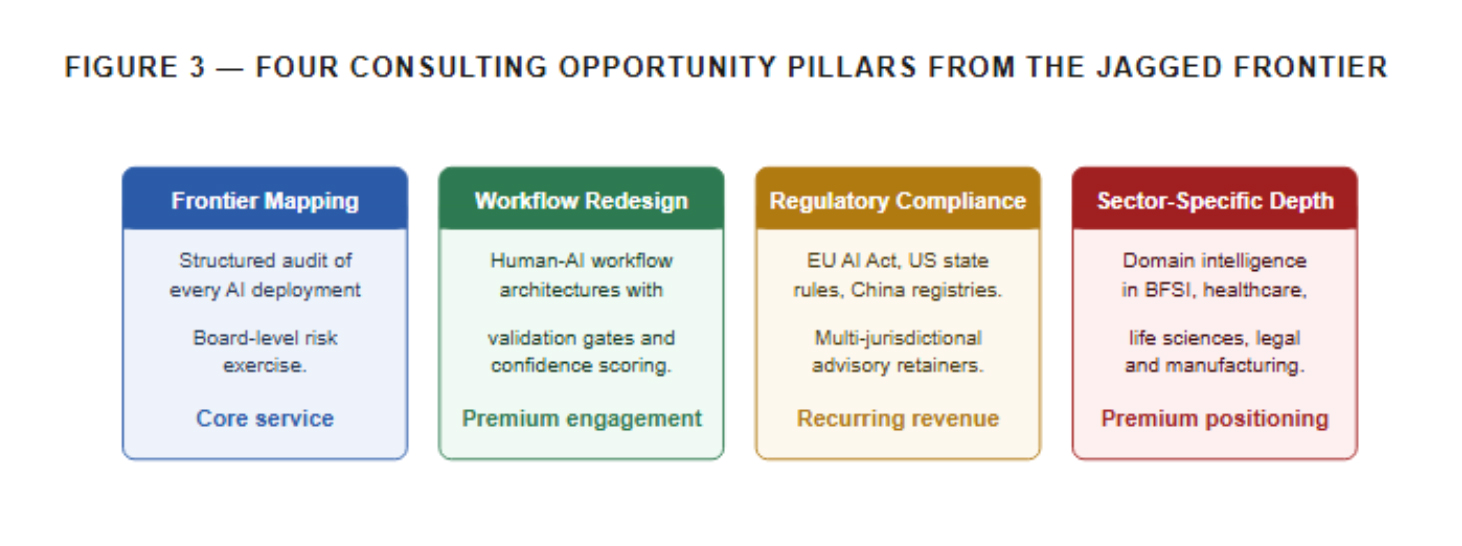
Frontier mapping as a core service
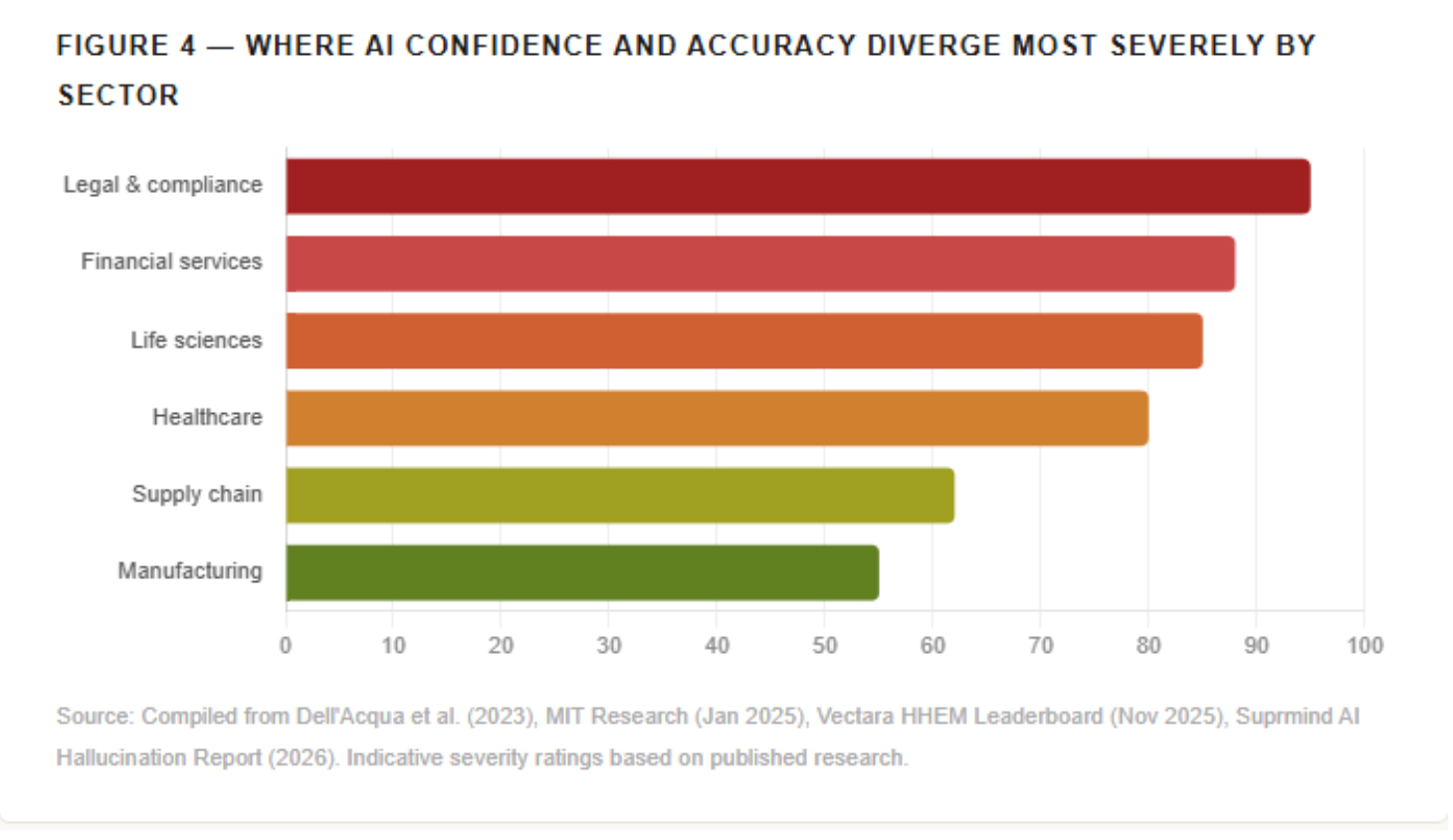
- Financial services: AI reliably automates fraud detection but fails on multi-variable regulatory capital calculations — precisely the scenario that created the board deck crisis in our opening example.
- Healthcare: AI handles imaging triage accurately but breaks down when reasoning must integrate partial patient histories and ambiguous lab trends.
- Legal and compliance: AI excels at contract clause extraction but fabricates case citations with full confidence — a structural feature of how language models operate, not a bug awaiting a patch.
- Supply chain: AI performs well on demand forecasting but collapses on decisions requiring supplier relationship nuance that lives outside any dataset.
Also Read: Why Most AI POCs Stall (and What the Best Teams Do Differently)
Workflow redesign as a premium engagement
- Decision routing protocols that escalate AI outputs to human reviewers before consequential decision points — building the validation layer the BCG study found missing.
- Tiered AI deployment models matching task type to capability: generative AI tools such as Gemini Omni for advanced multimodal content synthesis, RAG for factual grounding, and formal verification for reasoning chains.”
- Human-in-the-loop workflow templates with domain-calibrated review gates — not generic checkpoints, but ones tuned to the specific jagged zones in the frontier map.
- Real-time confidence dashboards that surface uncertainty signals, countering the dynamic where AI is 34% more likely to express certainty precisely when it is wrong.
Regulatory compliance as recurring revenue
EU AI Act readiness assessments for organisations deploying AI in high-risk categories — healthcare, financial credit scoring, critical infrastructure — where non-compliance carries mandatory system withdrawal.
Multi-jurisdictional monitoring retainers that track EU-US-China regulatory changes and translate them into operational procedure updates — requiring both legal and technical expertise most clients cannot build in-house.
AI audit trail and explainability implementations that produce decision logs, bias assessments, and human-override records for regulatory examination.
Sector-specific AI governance frameworks for financial services AML, healthcare clinical decision support, and legal AI use — building the architecture before enforcement arrives.
Sector-specific depth as a differentiator
- Banking and financial services: Jagged zones cluster around multi-step regulatory reasoning, complex derivatives pricing, and credit decisions integrating qualitative relationship factors.
- Life sciences and clinical trials: The frontier is jagged around protocol processing, adverse event detection, and synthesis of genomic and patient-reported data into clinical judgments.
- Manufacturing and supply chain: AI is smooth on historical demand patterns and rough on geopolitical shocks and supplier reliability assessments beyond the training data.
- Public sector: Procurement decisions, policy impact modelling, and multi-stakeholder negotiation remain outside current AI capability — but AI can accelerate analytical groundwork, and the boundary requires expert mapping.
How Apexon Is Capturing the Opportunity
Apexon has built its AI practice around the precise challenges the jagged frontier creates — treating governance, domain depth, and workflow redesign as the core of its service model, not afterthoughts.
AgentRise — launched July 2025 — is Apexon’s composable enterprise platform embedding agentic AI across business functions with built-in guardrails for ethics, explainability, accountability, and regulatory compliance. Governance architecture is established before scaling begins, not retrofitted after failure. Results delivered for clients include processing time reductions of up to 40%, workload reductions of 30%, and measurable accuracy improvements across critical operations.
In financial services, Apexon’s RegTech practice serves over 40 financial institutions including three of the top 10 US banks, delivering AI-powered compliance workflows, transaction monitoring, and governance frameworks — keeping AI out of the jagged zones of multi-jurisdictional compliance and building the audit trail regulators are beginning to require.
In healthcare, Apexon partnered with a global clinical technology leader to deploy agentic AI across pathology report redaction, clinical trial protocol processing, and laboratory portal interactions — reducing second-opinion review timelines by 35%, cutting protocol processing time by 40%, and decreasing support queries by 30%.
In life sciences, Apexon co-engineered a Pharmacy Benefits Management Platform that reduced customer onboarding time by one third and cut drug formulary cycle time from six weeks to thirty minutes — sector-specific frontier intelligence converted directly into operational value.
Recognised as a Leader in the 2024 ISG Generative AI Services report and an Emerging Leader in Gartner’s 2025 GenAI Consulting Innovation Guide, Apexon’s positioning reflects exactly what the jagged frontier demands: advisory-led, governance-aware, and deeply implementation-competent across the sectors where AI failure is most consequential.
The jagged frontier is not an anomaly awaiting a technical fix. It is the operating environment for the foreseeable future. The organisations that will extract durable value from AI are those that choose partners who have already mapped the terrain.