
Your engineers are not The constraint. Your operating model is.
40% of engineering time is wasted – not on coding, but on coordination, review, and rework. That is the problem this solves.
40% of engineering time is wasted – not on coding, but on coordination, review, and rework. That is the problem this solves.
Mid-market banks with AUM up to $500B cannot outspend larger peers on engineering talent. But they can dramatically outpace them on productivity. The constraint is not headcount, it is the operating model: how software is built, iterated, and governed.
Apexon does not deploy AI tools. We redesign the SDLC operating model using Agentic AI. The result: teams that deliver 3-4 x more developer output without adding headcount, while your compliance and governance posture gets stronger, not weaker.
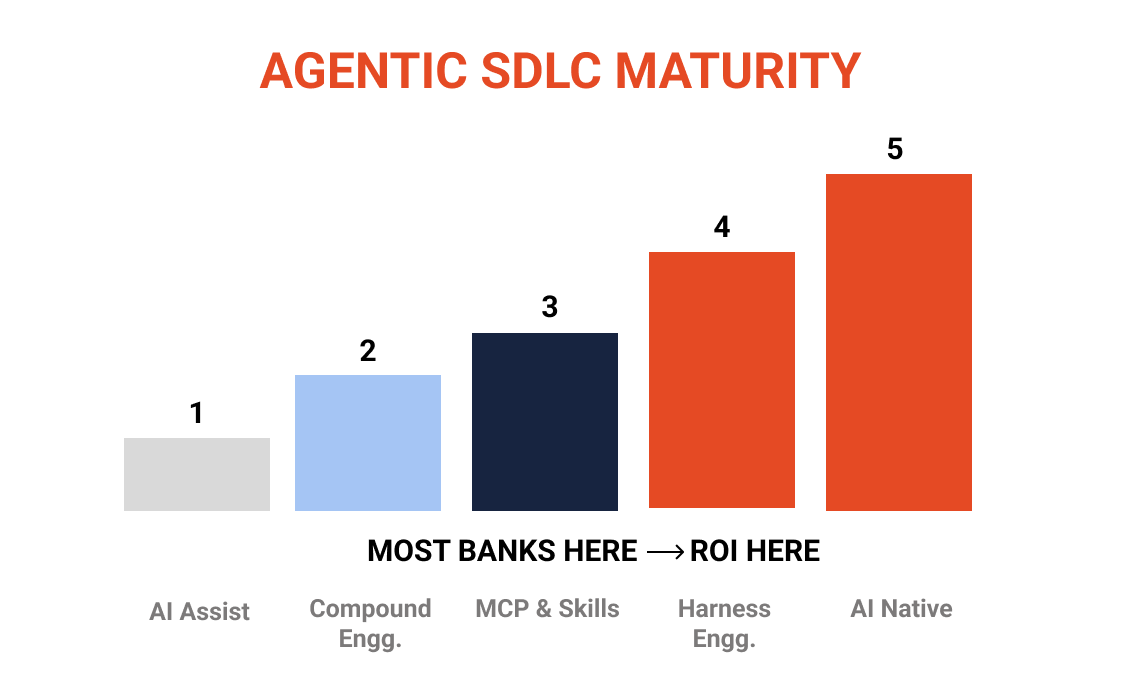
Most firms deploy AI tools and expect engineers to adapt. Apexon builds the automated quality gates, the knowledge infrastructure, and the governance layer — the operating model that makes agents produce reliable, deterministic output without constant human review. That is the difference between a productivity tool and a delivery operating model.
What industry leaders are achieving
Stage 4 agent-delegate teams vs traditional squads, same headcount, higher throughput.
Source: Harness Engineering deployment data
Per-engineer gain from AI-assisted IDEs and context engineering at Stage 1-2.
Source: AI IDE deployment benchmarks
End-to-end delivery effort reduction across testing, review, and governance gates.
Source: Full SDLC operating model transformation
Crawl-walk-run adoption with quantified outcomes at each phase.
Structured engagement model
Most mid-market banks are at Stage 1-2. The productivity uplift accelerates at Stage 3-4. The gap is not technical — it is organisational.
AI IDEs & copilots. Context engineering.
Codify knowledge. Agents context-aware.
Agent capability layer with governed access.
Automated quality gates. Deterministic output.
Developers govern; agents deliver fully.
90-day path from copilot to operating model transformation
The challenge: Senior engineers trapped in review queues. AI IDEs deployed but producing hallucinations in domain-specific code due to absent context engineering and no SDD foundation. Delivery velocity stalled despite tooling investment. Sound familiar?
PR throughput in 90 days
Code review cycle reduction
Reduction in onboarding time
From 7-week onboarding to productive
Operating model transformation helps engineering teams deliver faster by removing workflow bottlenecks, improving cross-functional collaboration, and aligning technology initiatives with business goals. A structured operating model transformation approach combines agile delivery practices, platform engineering, automation, cloud-native capabilities, and continuous optimization to help enterprises scale innovation, accelerate time-to-market, and increase ROI without adding more developers.
Operating model transformation is critical because engineering slowdowns are often caused by fragmented workflows, legacy governance, siloed teams, and inefficient delivery processes not a lack of developer talent. A structured operating model transformation approach combines agile delivery practices, platform engineering, intelligent automation, cloud-native capabilities, and continuous optimization to help enterprises improve software delivery speed, increase engineering productivity, and scale innovation without expanding team size.
An effective operating model transformation helps enterprises shift from fragmented delivery structures to a more agile, value-stream-oriented approach that aligns engineering efforts with business outcomes. Many organizations invest heavily in digital engineering, cloud platforms, and product development but still face delays caused by siloed teams, disconnected workflows, unclear ownership, and legacy governance models. By redesigning how teams collaborate and deliver value, organizations can improve engineering velocity, accelerate digital transformation initiatives, and achieve better business outcomes without simply increasing headcount.
An effective operating model transformation helps enterprises move from fragmented delivery models to a more agile, value-stream-oriented approach that aligns engineering efforts with business outcomes. Many organizations invest in digital engineering, cloud platforms, and product innovation but still face delays caused by siloed teams, disconnected workflows, and legacy governance. By improving cross-functional collaboration, accountability, and delivery alignment, businesses can increase engineering velocity, accelerate digital transformation, and unlock greater value from existing technology investments.
An effective operating model transformation helps enterprises eliminate the organizational friction that slows software delivery. Many organizations invest in digital engineering, cloud modernization, and product development but still struggle with siloed teams, inefficient workflows, and unclear ownership. By aligning teams around value streams, improving governance, and enabling outcome-driven delivery, businesses can accelerate time-to-market, increase engineering productivity, and maximize the return on existing technology investments without simply adding more engineers.
The first step in a successful operating model transformation is identifying the organizational constraints that limit engineering effectiveness and business outcomes. Many enterprises invest in digital engineering, cloud technologies, and product innovation, yet delivery slows due to siloed teams, fragmented processes, and unclear accountability. By assessing value streams, team structures, governance models, and delivery workflows, organizations can uncover bottlenecks and create a roadmap that improves collaboration, accelerates execution, and maximizes the impact of existing engineering investments.
An effective operating model transformation enables organizations to align platform engineering, product teams, and business stakeholders around shared outcomes. As enterprises scale digital products and modern technology ecosystems, siloed processes and fragmented ownership can slow innovation. By establishing product-led delivery models, streamlining governance, and improving collaboration across teams, organizations can accelerate release cycles, enhance customer value, and maximize the return on their technology and engineering investments.
An effective operating model transformation helps enterprises align product engineering, platform modernization, and business teams around shared outcomes. Many organizations invest in cloud-native platforms, digital products, and modernization initiatives but struggle with fragmented ownership and slow execution. By improving value stream alignment, governance, and cross-functional collaboration, businesses can accelerate innovation, increase delivery efficiency, and maximize the impact of their digital investments.