
The enterprise AI landscape is shifting from reactive copilots to proactive, goal-driven agents that can reason, plan, and execute complex workflows autonomously. This is not an incremental upgrade — it’s a foundational change in how intelligent systems interact with enterprise data, tools, and processes. Microsoft’s rapidly evolving ecosystem is making it possible for engineering teams to design and deploy agentic architectures at scale with built-in security, governance, and integration capabilities.
At the core of this transformation are Azure AI Foundry, AutoGen, Microsoft 365 Copilot, and Copilot Studio Agents. Together, they provide the building blocks for moving from prompt-and-response models to autonomous enterprise workflows.

Also Read: Transforming Route Optimization with AI: A Game-Changer for Logistics
What Is Agentic AI and Why It Matters
Agentic AI refers to AI systems that go beyond single-turn interactions, enabling multi-step reasoning, persistent memory, and autonomous tool usage. These agents:
- Break down complex goals into smaller, manageable subtasks.
- Maintain state and context across long-running workflows.
- Interact with APIs, databases, and enterprise systems.
- Collaborate with other agents or humans when necessary.
A key enabler is the ReAct framework – short for Reasoning and Acting — where an AI agent alternates between thinking (reasoning over context, data, and goals) and doing (invoking tools, APIs, or taking actions). This loop allows agents to solve problems step-by-step, adapt to new information, and maintain alignment with business objectives.
In more advanced scenarios, autonomous multi-agent orchestration comes into play – where multiple specialized agents coordinate to achieve a shared outcome. In Microsoft’s stack, this is facilitated by AutoGen’s orchestration patterns for building and managing multi-agent workflows, while Agent-to-Agent (A2A) protocol support in Azure AI Foundry and connected Copilot Studio environments enables secure cross-platform agent communication. The Model Context Protocol (MCP) further enhances interoperability by allowing dynamic discovery of tools and capabilities across agents. Together, these capabilities enable scalable, modular AI architectures that mirror how teams of humans collaborate on complex, interdependent tasks.
The Microsoft Agentic AI Stack
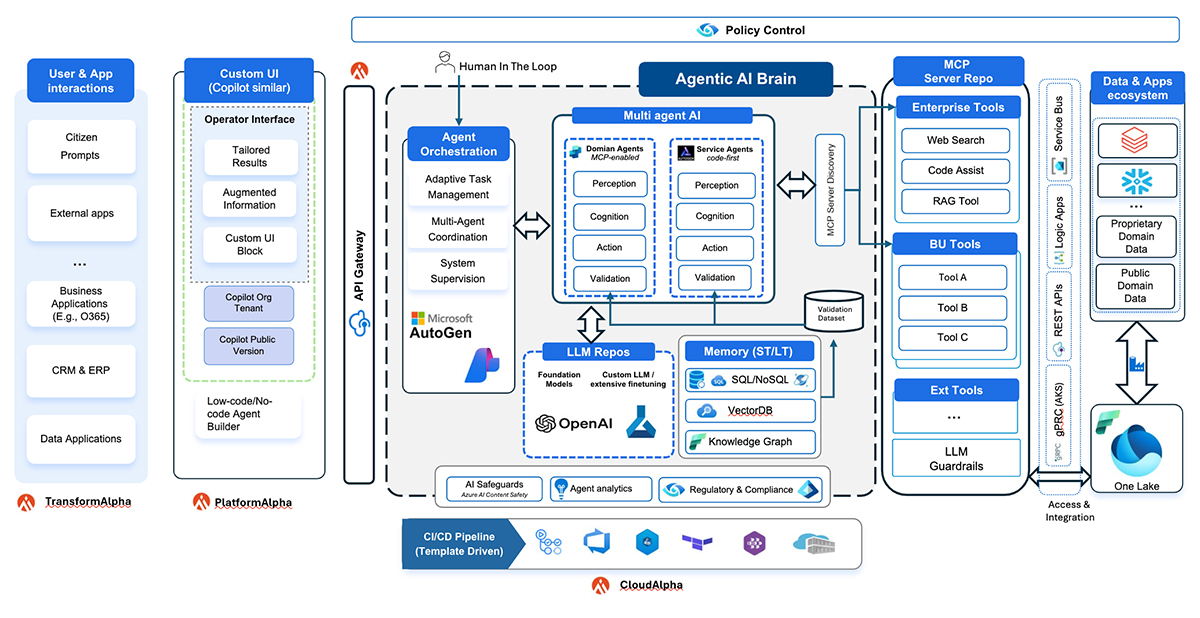
The Agentic AI “brain” is implemented with Microsoft’s ecosystem of tools: Azure AI Foundry for orchestration and lifecycle management, AutoGen for advanced multi-agent coordination, Copilot Studio for domain-specific agents (MCP-enabled), and Azure OpenAI for reasoning and generative intelligence. For persistent memory and knowledge, Microsoft Fabric’s OneLake provides the unified data foundation, with Azure AI Search, Cosmos DB, or SQL layered on for retrieval, structured persistence, and vectorized access. Microsoft Purview ensures governance, Entra ID enforces security, and Application Insights provides observability.
At Apexon, these capabilities are accelerated through our Alpha suites (Cloud AlphaTM, Platform AlphaTM, Transform AlphaTM), where we’ve built proprietary IPs and accelerators that reduce time-to-value. Examples include multi-agent orchestration frameworks, pre-built connectors, and industry-specific agent templates for BFSI, Healthcare, Logistics, and Retail. These assets ensure that implementations are production-ready, secure, and compliant from day one.
Importantly, the surrounding layers remain platform-neutral, enabling integration with any enterprise system—CRM, ERP, data lakes, or custom line-of-business applications—via APIs or MCP. This makes the architecture extensible across heterogeneous environments.
Also Read: Empowering AI-Driven Insights: Enhancing Monitoring and Analysis with Generative AI
Azure AI Foundry
A central hub for building, managing, and scaling AI solutions. Azure AI Foundry lets enterprises develop, evaluate, and deploy agents with consistent governance, compliance, and integration to Azure services. Through integrations with Azure AI Foundry, teams can rapidly move from experimentation to production while maintaining enterprise-grade controls. It also supports Agent-to-Agent (A2A) protocols for secure cross-platform agent communication and coordination.
AutoGen
The orchestration layer that allows multiple agents to communicate, delegate, and resolve tasks together. AutoGen supports persistent context sharing, structured hand-offs, and event-driven workflows, making it essential for multi-agent environments. When used alongside A2A protocol–enabled platforms like Azure AI Foundry and combined with the Model Context Protocol (MCP) for dynamic tool discovery, AutoGen helps enable adaptive systems that respond dynamically to business needs.
Azure OpenAI Service
The intelligence layer powering natural language understanding, reasoning, and generation. Azure OpenAI provides enterprise-grade access to GPT models and multimodal capabilities, enabling agents to perform tasks such as summarization, dialogue, knowledge retrieval, and creative generation. Integrated with Azure AI Foundry, AutoGen, and Copilot Studio, it ensures that advanced generative AI capabilities are secure, governed, and aligned with organizational compliance requirements.
Microsoft 365 Copilot
Embedded across familiar productivity tools like Word, Excel, Outlook, and Teams, Microsoft 365 Copilot uses enterprise data from Microsoft Graph to augment knowledge work. It can be extended with Copilot Studio to act as part of a broader agentic ecosystem — triggering workflows, invoking APIs, and collaborating with other agents in response to business events.
Also Read: AI for Predictive Analytics: Everything You Need to Know
Copilot Studio Agents
Copilot Studio now supports multi-agent capabilities and integrates with MCP for tool and capability discovery. This enables dynamic adaptability — agents can learn about new capabilities without code changes, while still respecting enterprise authentication, authorization, and compliance policies.
Applied Engineering: Real-World Use Cases
Agentic AI is not limited to a single domain — its potential spans vertical industries and horizontal business functions alike.
Vertical Industry Scenarios:
- BFSI (Banking, Financial Services, Insurance): Autonomous KYC processing, compliance reporting, claims handling.
- Healthcare: Patient intake agents, care plan coordination, regulatory documentation.
- Logistics & Transportation: Shipment tracking, proactive route optimization, customs clearance.
- Retail & E-Commerce: Inventory balancing, personalized promotions, supply chain coordination.
Horizontal Business Functions:
- Business Process Automation (Finance, HR, Operations): Intelligent case routing, expense validation, onboarding workflows.
- IT Operations: Automated incident triage, self-healing scripts, environment provisioning.
- Customer Experience: 24/7 service agents that can resolve issues end-to-end, escalating only when necessary.
Why This Matters for Enterprises
Unlike traditional automation, agentic AI adapts in real time, works across siloed systems, and can collaborate with humans or other agents without pre-programmed scripts. This makes it particularly powerful in:
- Dynamic Environments: Where business rules or conditions change frequently.
- Complex, Multi-Step Processes: That require contextual understanding and prioritization.
- Cross-Functional Scenarios: Involving multiple departments, systems, and stakeholders.
By leveraging Microsoft’s secure cloud ecosystem, enterprises can implement these capabilities without compromising governance, data privacy, or compliance — while taking advantage of existing investments in Azure and Microsoft 365.
Final Thoughts
Agentic AI represents a shift from task assistance to autonomous execution. Microsoft’s technology stack enables this evolution with a blend of development flexibility, operational governance, and deep integration into enterprise environments. Looking ahead, we can expect more seamless collaboration between agents, humans, and systems. This will blur the lines between “automation” and “collaboration,” creating adaptive workflows that continuously learn, optimize, and deliver value.
The question now is not whether your organization will adopt agentic AI — it’s how soon your agents will be working alongside your teams, and what goals they’ll be achieving while you focus on the bigger picture.